
Architectural Glass
Toughened glass
Toughened glass is float glass heated and rapidly cooled so it is stronger and breaks into blunt granules. ARG toughens clear glass from 4 mm to 19 mm, and coated glass, as a single pane.
Also called Tempered glass.
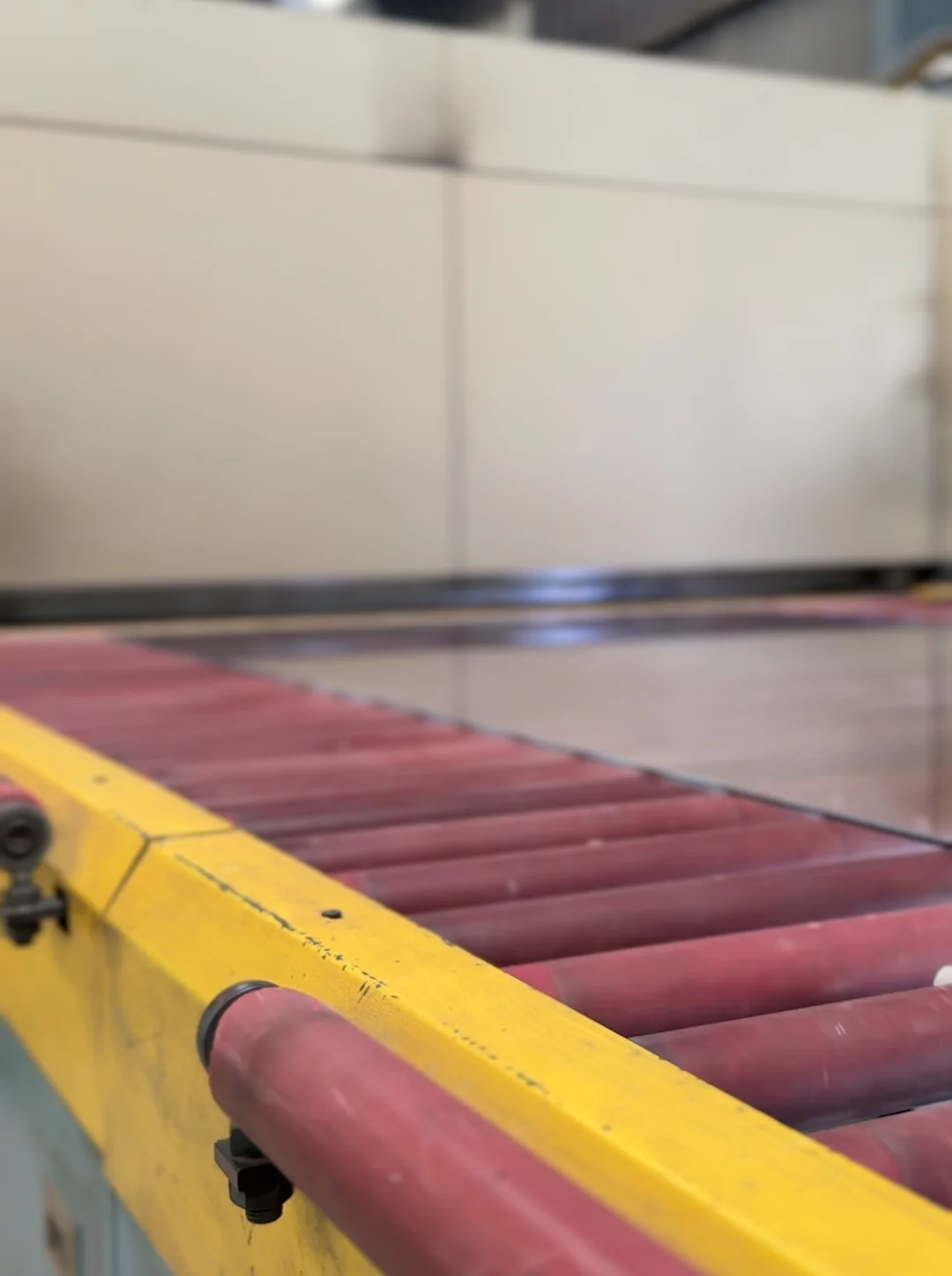 Glass leaving the toughening furnace at the ARG plant
 - Thickness 4 · 5 · 6 · 8 · 10 · 12 · 15 · 19 mm
- Coatings ST167 · ST150 · ST136
- Sold as Single pane, no lamination or insulated unit required
- Sourcing Processed in-house
Heat soak
Heat-soaked toughened glass, for the panes that must not break on their own.
Toughened glass can, rarely, break on its own with nothing touching it. The cause is a nickel sulphide inclusion, an impurity that is seldom present in float glass but that slowly changes form inside a toughened pane and can shatter it months after installation. IS 2553 (Part 1) describes the risk in its Annex C.
Heat soaking is the treatment that finds those panes before they leave the plant. The toughened glass is held in an oven for several hours at about 280 degrees, which hurries the change in any inclusion so that a pane carrying one breaks in the oven rather than on the building. The standard notes that the process reduces the risk significantly without eliminating it entirely, and recommends it wherever the stability of the structure or the safety of people would be at risk from a pane breaking.
Heat-soaked glass keeps every property of toughened glass. It is the same pane, tested. Ask for it by name on the enquiry and say where the glass goes.
- Structural balustrades
- Infill balustrades where fall-out is a concern
- Sloped and overhead glazing
- Spandrels that are not heat-strengthened
- Structural glazing on spider or point fittings
- Commercial exterior frameless doors
The list is the one ARG published on its earlier website for the applications to consider heat soaking for; the description of the risk and the treatment follows IS 2553 (Part 1) Annex C, which is informative rather than mandatory.
Full specifications: Toughened Glass
| Thickness | 4 · 5 · 6 · 8 · 10 · 12 · 15 · 19 mm |
|---|---|
| Coatings | ST167 · ST150 · ST136 |
| Sold as | Single pane, no lamination or insulated unit required |
| Sourcing | Processed in-house |
Full technical detail, in question form
Can toughened glass be used on its own?
Yes, and this is the fact most enquiries get wrong. Clear glass across the full thickness range, and the coated glasses ST167, ST150 and ST136, can all be supplied as a single toughened pane. There is no requirement to build them into an insulated unit or a laminate first.
That matters commercially. A shopfront, a shower screen, a balustrade infill or a partition can be specified as one toughened pane rather than as an assembly, which changes both the lead time and the price.
What thicknesses does ARG toughen?
Clear glass at 4, 5, 6, 8, 10, 12, 15 and 19 mm. The thinner end covers joinery, wardrobe fronts and light partitions; 10 mm and above is where structural and frameless work sits.
What are ST167, ST150 and ST136?
They are Saint-Gobain coated glass codes. ARG names these three specifically as glasses that can be toughened and sold standalone.
A note on how to read them: the codes are the manufacturer’s, not ARG’s. This page gives no light transmission, solar factor or U-value figure for any of the three, because those are the glass maker’s published numbers and we are not going to restate them second-hand. Ask us which code suits the elevation and we will talk it through.
How toughening changes the glass
Toughening is a heat process: the pane is taken to around its softening point and then cooled rapidly, putting the surfaces into compression and the core into tension. Two consequences follow. The pane becomes substantially stronger than annealed glass of the same thickness, and when it does fail it breaks into small blunt granules instead of shards, which is why it is the safety glass of choice for anywhere a person can walk into it.
The trade-off is that everything must be finished first. Cutting, drilling, notching and edge work all happen before the furnace. A toughened pane cannot be modified afterwards.
Lead time
Standard toughened glass runs on a 3-day standard lead from confirmed sizes. Send the site date with the enquiry and we confirm the dispatch date against it.
What ARG needs from you to quote
Final sizes in millimetres, thickness, edge finish and any holes or cut-outs with their positions. If the glass is coated, tell us which face the coating should sit on. If you are not sure, send the drawing on WhatsApp and we will come back with the build-up.
What does heat soaking do, and does ARG offer it?
Heat soaking is an extra treatment after toughening: the pane is held in an oven for several hours at about 280 degrees. A toughened pane that carries a nickel sulphide inclusion, a rare impurity in float glass, can break on its own long after installation as the inclusion slowly changes form; the oven hurries that change so such a pane breaks in the plant instead. IS 2553 (Part 1) describes the risk in its Annex C and recommends the treatment wherever a pane breaking would put the structure or people at risk. It reduces the risk significantly without removing it entirely. ARG’s earlier website listed the applications to consider it for: structural and infill balustrades, sloped and overhead glazing, spandrels that are not heat-strengthened, structural glazing on spider fittings and commercial exterior frameless doors. Ask for heat-soaked glass by name on the enquiry and say where the pane goes.
Read next
Common questions
Does toughened glass have to go into a double glazed unit or a laminate?
No. ARG states that clear glass from 4 mm to 19 mm, and the ST167, ST150 and ST136 coated glasses, can all be sold as a single toughened pane with no insulated unit or lamination required.
What thicknesses of clear glass can ARG toughen?
4, 5, 6, 8, 10, 12, 15 and 19 mm.
What is heat-soaked glass, and when should I ask for it?
Toughened glass that has been held for several hours at about 280 degrees after toughening, so that a pane carrying a nickel sulphide inclusion breaks in the oven rather than on the building. IS 2553 (Part 1) recommends it wherever a pane breaking would put the structure or people at risk: balustrades, overhead glazing, spider-fitted structural glazing, frameless exterior doors. Ask for it by name on the enquiry.
Can toughened glass be cut or drilled after toughening?
No. Toughening is the last step, every cut, hole, notch and edge finish is made before the pane enters the furnace, because a toughened pane shatters if it is worked afterwards. Send the final sizes with the enquiry.
Quote it from the drawing.
Final sizes in millimetres, or a photograph of the drawing, on WhatsApp. We come back with a build-up and a price against it.